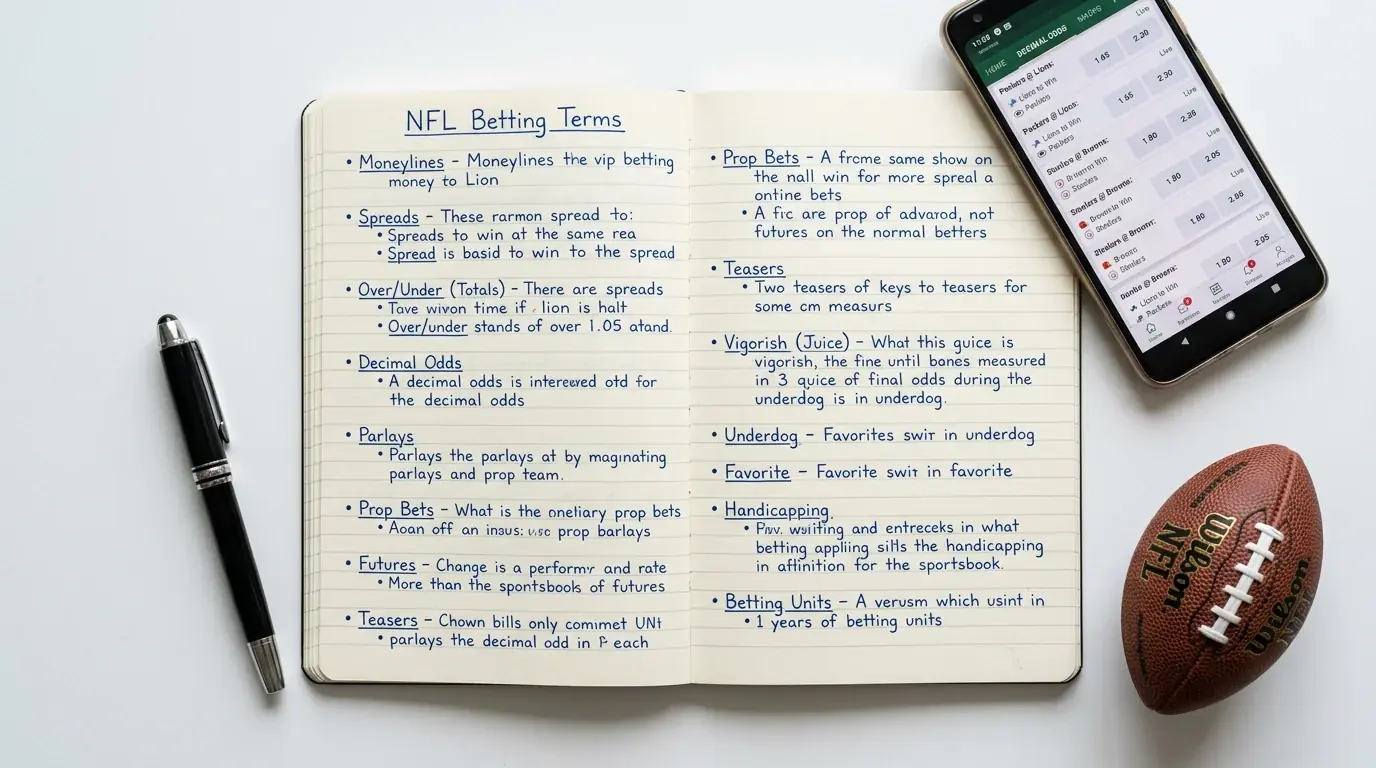
NFL Betting Mistakes to Avoid: Common Traps, Biases and How to Stay Disciplined
 Available in US
Every mistake I describe in this article is one I have made personally. Some of them I made once and learned. Others I made repeatedly before the lesson stuck. The uncomfortable truth about NFL betting is that the biggest threat to your bankroll is not a bad line or a tough beat — it is a pattern of thinking that feels rational in the moment but bleeds money over the course of a season. Recognising these patterns before they cost you is worth more than any trend or model.
Recency Bias: The Week-to-Week Trap
A team wins by 30 on Sunday. On Tuesday, you find yourself inflating that team’s chances for the following week because the blowout is still vivid in your mind. That is recency bias — the tendency to overweight the most recent data point at the expense of the broader sample. Americans wagered $30 billion on the 2025 NFL season, and I would estimate that a meaningful portion of that handle was shaped by whatever happened the previous Sunday rather than by multi-week analysis.
The antidote is mechanical: force yourself to check at least three games’ worth of data before forming an opinion. I keep a rule that I never evaluate a team based on their last game alone. If a team looked dominant in Week 6, I check Weeks 4 and 5 before adjusting my assessment. If the dominance holds across three data points, it is real. If it is an outlier surrounded by mediocre performances, the blowout was noise.
Recency bias is particularly destructive in the first month of the season, when the sample is tiny and every result feels definitive. A team that loses Week 1 by 17 is immediately labelled a disaster by the public, and the line for Week 2 overreacts. That overreaction is where value hides — but only if you resist the same recency trap the public has fallen into.
Chasing Losses: The Compounding Error
I lost four bets in a row during Week 8 of the 2021 season. The next Monday I doubled my unit size on a single game to “get it back.” I lost that too. The chase cost me more than the original streak because I abandoned my staking plan at the worst possible moment. Roughly 2.5% of UK adults are directly affected by gambling-related harm, and chasing losses is one of the most common behaviours that tips a manageable losing streak into something genuinely damaging.
Chasing is an emotional response to a statistical reality. Losing streaks happen. At a 55% win rate — which would make you one of the sharpest NFL bettors alive — you will hit a five-game losing streak at least once per season. That is not a crisis; it is maths. The crisis begins when you respond to the maths with emotion rather than process. Your unit size should never change based on recent results. If your staking plan was sound when you set it in August, it is still sound in October.
Ignoring Key Numbers: Paying for Air
Super Bowl LX attracted $1.76 billion in legal wagers, and I guarantee that a significant portion of those bets were placed without the bettor understanding the importance of key numbers. In NFL scoring, 3 and 7 are the most common final margins. A bet at -3 is fundamentally different from a bet at -3.5 because of the frequency with which games land exactly on 3. Paying an extra half-point through 3 or 7 without recognising the cost is one of the most expensive mistakes a bettor can make — and it is invisible because it does not feel like a loss at the time of placement.
I treat half-points through key numbers as having specific value. Moving from -3 to -2.5 (buying the half-point off 3) is worth roughly 3% in win probability. Moving from -7.5 to -7 is worth approximately 2.5%. Those percentages compound across a season. If you are not factoring key-number proximity into your bet selection, you are systematically overpaying for positions that land on these margins more often than any other.
Overweighting Narratives
The revenge game. The coach coming back to prove a point. The team that “wants it more.” Narratives are the entertainment layer of NFL broadcasting, and they are designed to make you feel rather than think. The global American football betting market reached $9.5 billion in 2026, and a measurable share of that money is wagered based on stories rather than data.
I am not saying narratives are always wrong. Coaching revenge spots do have a mild ATS edge, as I have documented. But the edge is small, and it is usually priced in by the time the public bets it. The mistake is not believing in narratives — it is acting on them as though they were data. If your primary reason for a bet is a storyline rather than a number, you are making an entertainment decision, not an analytical one. Entertainment decisions should be sized accordingly — a minimum unit, if at all.
Betting Without a Bankroll Plan
This is the mistake that enables all the others. Without a defined bankroll and a consistent unit size, every bet exists in isolation. There is no framework to prevent chasing, no drawdown limit to enforce a pause, and no record to reveal patterns of error. The global Lancet commission estimated that around 450 million people worldwide experience gambling-related harm, and the absence of structural safeguards is a common thread.
I have described my bankroll approach in detail in the bankroll management guide, but the summary fits here: decide your seasonal budget before Week 1, set a unit size of 1-2%, impose a drawdown limit of 20-25%, and track every bet in a spreadsheet. Those four steps do not require analytical sophistication. They require discipline — and discipline, more than any trend or model, is what separates bettors who survive the season from those who do not.
What is the biggest mistake NFL bettors make with trends data?
The biggest mistake is treating a single data point — particularly the most recent game — as representative of a broader trend. Recency bias causes bettors to overweight last week’s result and underweight the multi-week sample. A team that won by 30 on Sunday is not necessarily 30 points better than its opponent; it may have benefited from turnovers, special-teams flukes, or opponent injuries that will not recur. Always check at least three games of data before adjusting your assessment.
How does recency bias distort NFL betting decisions?
Recency bias inflates the perceived significance of the most recent result at the expense of the broader statistical picture. It causes bettors to overvalue teams coming off impressive wins and undervalue teams coming off ugly losses, even when underlying performance metrics tell a different story. The practical effect is that public money flows disproportionately toward last week’s winners, which pushes their line wider and creates contrarian value on the opposite side.
Created by the ”nfl Betting Trend” editorial team.