
NFL Parlay Betting Trends: Same-Game Parlays, Correlation Edges and Expected Value
 Available in US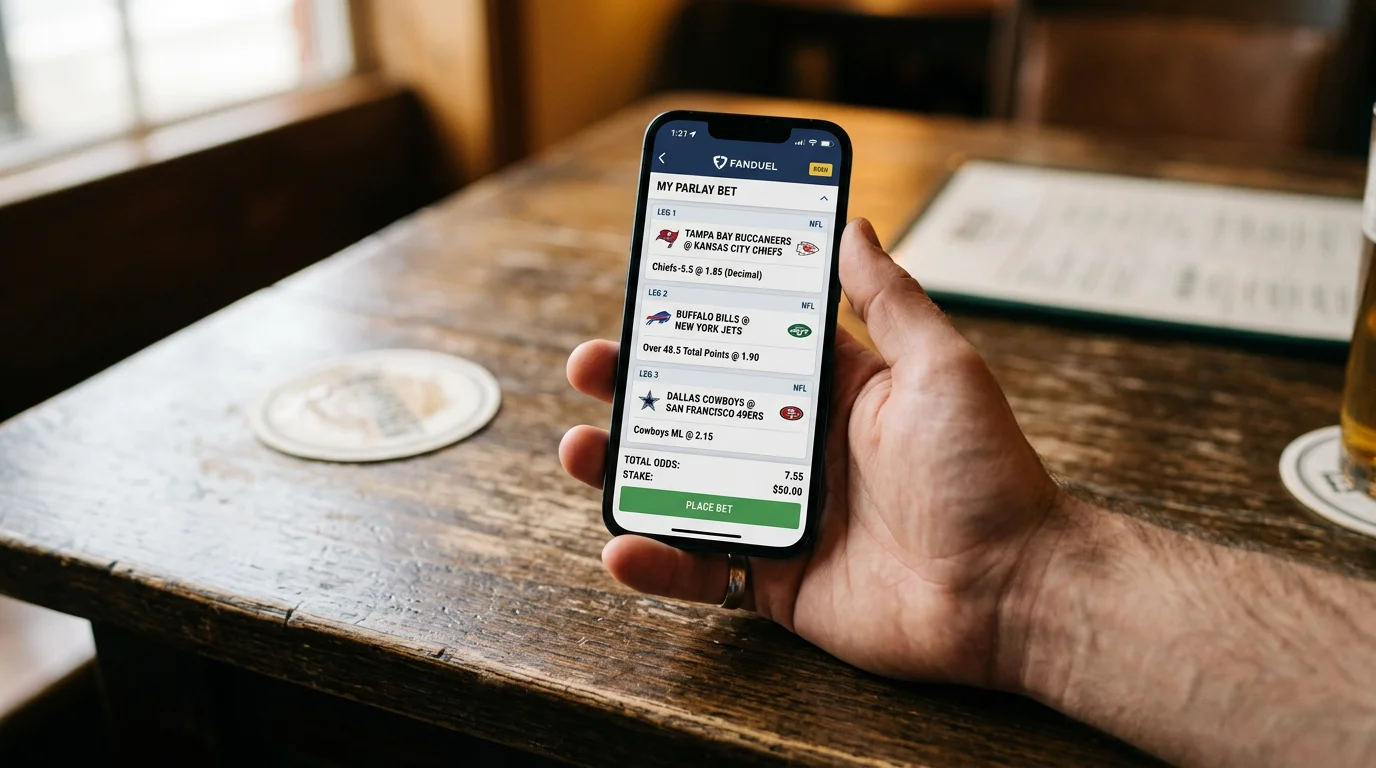
I have a confession: I love parlays. I also know they are, in aggregate, the most profitable product bookmakers sell. That tension — between the entertainment value and the mathematical reality — is what makes parlays the most misunderstood bet type in the NFL. They are not inherently bad bets. They are bad bets when assembled carelessly. Done with precision, a well-constructed parlay exploits a specific market weakness that single bets cannot touch: correlation.
How NFL Parlays Work
A parlay combines two or more individual selections into a single wager. Every leg must win for the bet to pay out. The appeal is obvious: the potential payout is far larger than any individual bet. A two-leg parlay at standard -110 pricing pays roughly 2.64/1. A three-leg parlay pays roughly 6/1. A four-leg pays roughly 12.3/1. Americans wagered $30 billion on the 2025 NFL season, and parlays accounted for a growing share of handle because the large payouts attract recreational bettors willing to risk small stakes for outsized returns.
The mathematical cost is equally obvious. Each additional leg multiplies the probability of failure. A single bet at 52% win probability pays over the long run. A two-leg parlay requires both legs at 52%, which means your effective win probability is 27% — and you need to win roughly 37% of the time at standard two-leg pricing to break even. A three-leg parlay at 52% per leg has an effective win probability of just 14%. The more legs you add, the further your actual hit rate falls below the required breakeven rate.
This is why I restrict myself to two-leg parlays and, very rarely, three-leg. Beyond three legs, the maths turns punitive regardless of how strong each individual selection looks.
Same-Game Parlays: The Bookmaker’s Favourite Product
Same-game parlays — combining multiple selections from a single game — have exploded in popularity. Live and in-play betting now accounts for 53.4% of all wagers globally, and SGPs have been a major driver of that growth because they keep bettors engaged with granular, play-by-play outcomes.
The problem with most SGPs is that the bookmaker prices each leg independently and then applies a margin to the combination. But the legs are not independent. If you parlay “Team A to win” with “Team A’s quarterback to throw 2+ touchdowns,” those outcomes are positively correlated — if Team A wins, their quarterback is more likely to have thrown multiple touchdowns. The bookmaker’s pricing treats them as separate events, which inflates the payout on paper but actually under-compensates for the correlation. You are getting paid for two independent bets when you are really making one conditionally linked bet.
That said, correlation cuts both ways. Some SGP combinations are negatively correlated, and the bookmaker’s pricing does not always reflect that either. If you parlay “the under” with “a running back to rush for 100+ yards,” those outcomes are somewhat correlated — a run-heavy game that produces a 100-yard rusher is not necessarily a low-scoring game. The risk of the legs conflicting is priced away in the independent-leg model, making the true probability of both hitting lower than the odds imply.
Correlation Edges: Where Parlays Become Strategic
The profitable use of parlays requires identifying positively correlated outcomes that the bookmaker prices as independent. In the NFL, the clearest correlation edges involve game script. If you believe a game will be a blowout, several outcomes become correlated: the favourite covers a large spread, the over hits (blowout games often produce high combined scores as the trailing team chases), and the favourite’s running back racks up yards in garbage time. Combining the favourite’s spread with the running back’s rushing over in a two-leg parlay captures a correlation the bookmaker underprices.
Conversely, if you project a defensive grind, the under and the underdog covering are correlated — low-scoring games produce tight margins, and tight margins help the team getting points. A two-leg parlay of the under and the underdog ATS is a strategically sound combination when the game profile supports both.
The global American football betting market hit $9.5 billion in 2026, and correlation-based parlays represent a niche within that market where informed bettors can find genuine mathematical edges. The key discipline is to never add a leg simply to inflate the odds. Every leg must have independent analytical justification and a logical correlation to the other legs. If you cannot articulate why two outcomes are linked, you are assembling a lottery ticket, not a strategy.
Expected Value Reality: Parlays Over a Season
I track my parlays separately from my straight bets, and the results are instructive. Over the last three seasons, my two-leg parlays have produced a small positive ROI — roughly 3-4% — while my three-leg parlays have been slightly negative. The pattern confirms the theory: two-leg correlation parlays, carefully selected, can be profitable. Beyond two legs, the accumulated margin cost overwhelms even well-constructed combinations.
The emotional trap is variance. A good parlay bettor might hit 28% of their two-leg bets — well above the breakeven threshold — but that means 72% of the time you are watching both legs lose. The losing streaks feel longer and harder than with straight bets, even when the long-term maths is positive. Discipline means continuing to size your parlay stakes at the same unit level as your straight bets (or smaller) and resisting the temptation to chase a big payout by adding legs after a dry stretch.
For a deeper look at how prop bets can serve as parlay legs with exploitable correlation, the prop bet trends analysis breaks down which player categories offer the widest edges. The strongest parlays I build each week typically combine a spread or total with a player prop — two selections from different market pools whose outcomes are linked by the same game script.
Are same-game parlays good value or primarily a bookmaker edge?
Most same-game parlays favour the bookmaker because the legs are priced as independent events when they are actually correlated. However, informed bettors can exploit this mispricing by identifying positively correlated outcomes — situations where one outcome makes the other more likely — and combining them. The edge exists specifically because the bookmaker’s pricing model undervalues correlation. Without a clear correlation thesis, SGPs are a negative-expected-value product.
What is the historical hit rate for two-leg NFL parlays?
At a per-leg win rate of 52-53%, a two-leg NFL parlay hits approximately 27-28% of the time. The breakeven hit rate at standard -110 two-leg parlay pricing is roughly 37%, which means you need to find legs with win probabilities significantly above 52% or exploit correlation between legs to make two-leg parlays profitable over a season. The maths becomes progressively more punitive with each additional leg added.
Prepared by the nfl Betting Trend editorial staff.